
 English
 中文简体
中文简体 Español
 Português
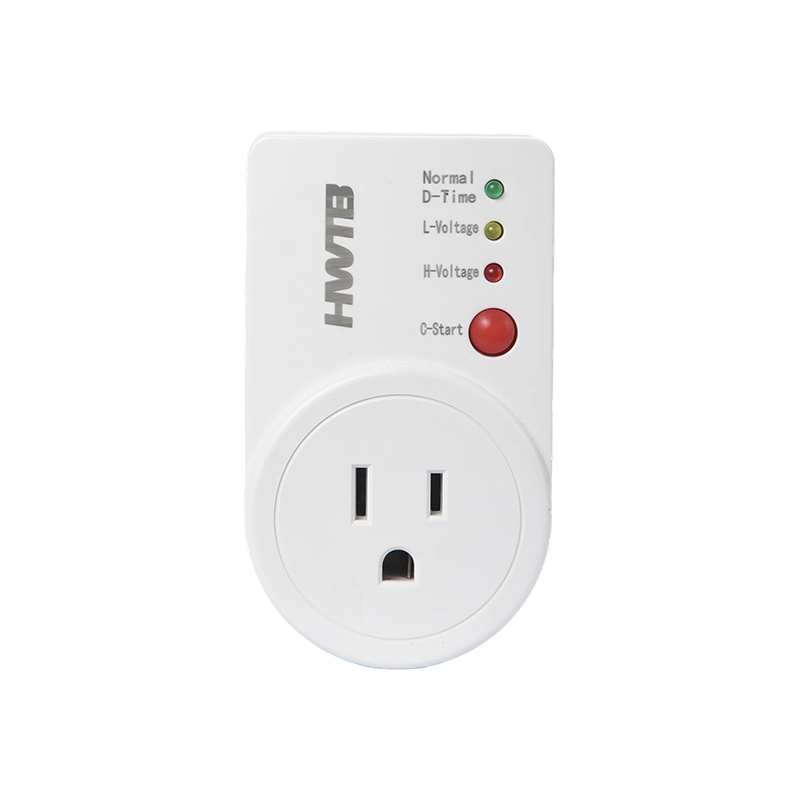
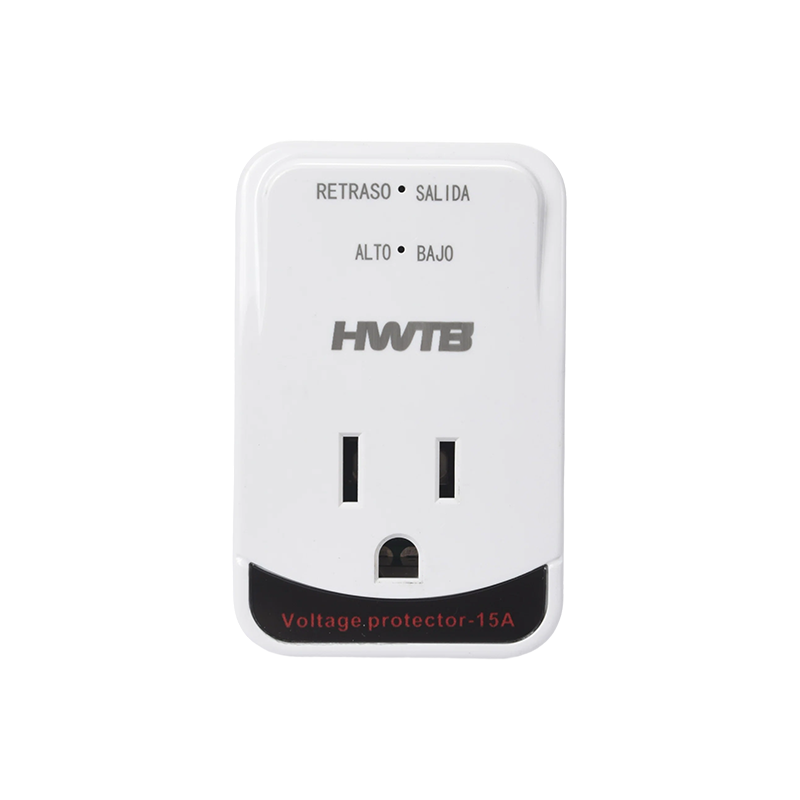
Look at the label on almost any surge protector and you will see voltage figures that seem to contradict each other: a device made for a 120 V circui...
READ MORE
Industry News
Home / News / Industry News / Voltage Regulator or Surge Protector for TV: Which One Does Your Screen Need?
Voltage Regulator or Surge Protector for TV: Which One Does Your Screen Need?
Update:03-09-2026
Power protection, explained
Voltage Regulator or Surge Protector for TV: Which One Does Your Screen Need?
Spikes, sags and slow brownouts damage a television in different ways, and no single device covers all three. This guide matches the hardware in the wall to the behavior of the grid outside it.
The question usually arrives right after the first scare: the lights dim when the air conditioner starts, the picture stutters, the set reboots to its startup logo, and the warranty suddenly feels thin. So the short answer comes first. On a stable urban grid, a quality surge protector with a genuine joule rating is all a television needs. Where voltage sags every summer evening and creeps high at night, an automatic voltage protector belongs between the socket and the screen, and a full regulator earns its place only on genuinely unstable supply.
The reason lies in how a modern TV is built. Its switch-mode power supply shrugs off ordinary variation and accepts a wide input range, but it was never designed to absorb repeated high-energy transients or to idle for hours at the edge of an undervoltage window. Those are two different failure modes, and they call for two different devices.
A surge protector answers what just struck the line. A voltage protector answers what the socket has been doing all day.
Three Devices, Three Different Jobs
A surge protector is a one-way trap. A metal-oxide varistor inside clamps a transient within nanoseconds and shunts the excess energy to ground, spending a little of its own capacity with every hit. It does that one job well, and it does nothing else: chronic 240 volts on a 120-volt circuit, or a nightly dip to 95 volts, passes straight through it untouched.
A voltage regulator, usually sold as an AVR, is the opposite temperament. It watches the output continuously and corrects it, stepping sagging voltage up and swollen voltage down through transformer taps or a servo drive. That is exactly right for equipment that must hold a tight tolerance around the clock, and more than one television requires in most homes, which is why regulators are heavier, dearer and rarely found under the TV cabinet.
Between the two sits the device most people are actually searching for: the automatic voltage protector. It monitors the supply continuously, disconnects the load when voltage leaves its preset band, waits out a timed delay, and reconnects only after the line has settled. That delay matters more than it sounds, and our explainer on what a voltage protector actually does to protect a television walks through the sequence in detail.
Info. A protector never adjusts voltage, and a regulator rarely pays for itself on a single television. Matching the failure mode you actually face to the device that addresses it is the entire decision.
Match the Device to Your Grid, Not to the Brochure
Region and infrastructure decide the answer, not brand names. The table below maps the conditions homeowners describe most often to the device that fits them.
| Grid condition | What you notice | Best-fit device | Why it works |
|---|---|---|---|
| Stable urban supply with a storm season | Rare flickers, mostly during lightning | Surge protector rated 1,000 joules or more | Transients are the only credible threat, and the TV supply absorbs everyday variation. |
| Air-conditioner-heavy summers, long rural lines | Lights dim at compressor start, TV reboots | Automatic voltage protector with under-voltage cutoff | Disconnects before the sag stresses the power board, returns after a timed delay. |
| Feeders with chronic overvoltage | Bulbs fail early, adapters run hot | Adjustable voltage protector tuned to a local ceiling | A user-set high limit holds the line instead of a factory default. |
| Generator or inverter supply | Erratic charging, hum in audio gear | Regulator ahead of a surge-protector stage | Continuous correction suits swings that are constant rather than occasional. |
Danger. After an outage, returning voltage often rebounds in uneven steps before it settles. A device that reconnects instantly walks the television straight into that rebound, so a reconnect delay of 30 seconds or more is worth checking before you buy.
Reading the Label: Specifications That Matter
Ignore the response-time figures printed in nanoseconds; any competent design clamps faster than a rising surge can reach the panel. Buy against four numbers instead.
- Energy absorption: at least 1,000 joules for a television plus its media stack, and closer to 2,000 where thunderstorms are frequent.
- Clamping voltage: on a 120-volt line, look for the 330-400 V category under UL 1449; the lower the listed figure, the earlier the unit begins working. On 230-volt systems, expect proportionally higher listed limits.
- The protection window: for voltage protectors, check the low and high cutoff values, whether they are adjustable, and the reconnect delay that follows a trip.
- Current rating matched to the load: a 65-inch television draws well under 2 amps alone, a shared media point justifies 15 amps, and air-conditioner-grade units run at 30 amps.
Warning. A basic power strip is not a surge protector, and daisy-chaining strips defeats both the protection and the fuse logic. If the packaging cannot state a joule rating or a listed standard, treat it as extra outlets and nothing more.
A Home-Theater Point, Done Properly
Picture the common setup: a 65-inch panel, a soundbar, a streaming box and a games console sharing one wall point. That cluster is exactly what multi-outlet automatic voltage surge protection was built for — one protection circuit and one cutoff decision covering every device plugged into it, so a sag cannot knock out the television while the soundbar limps on untreated.
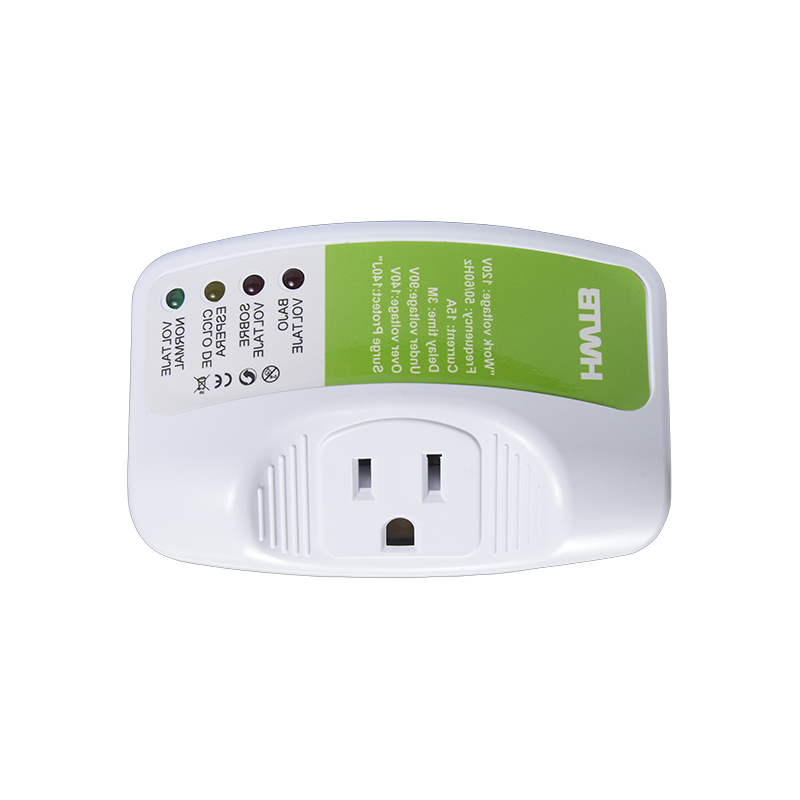
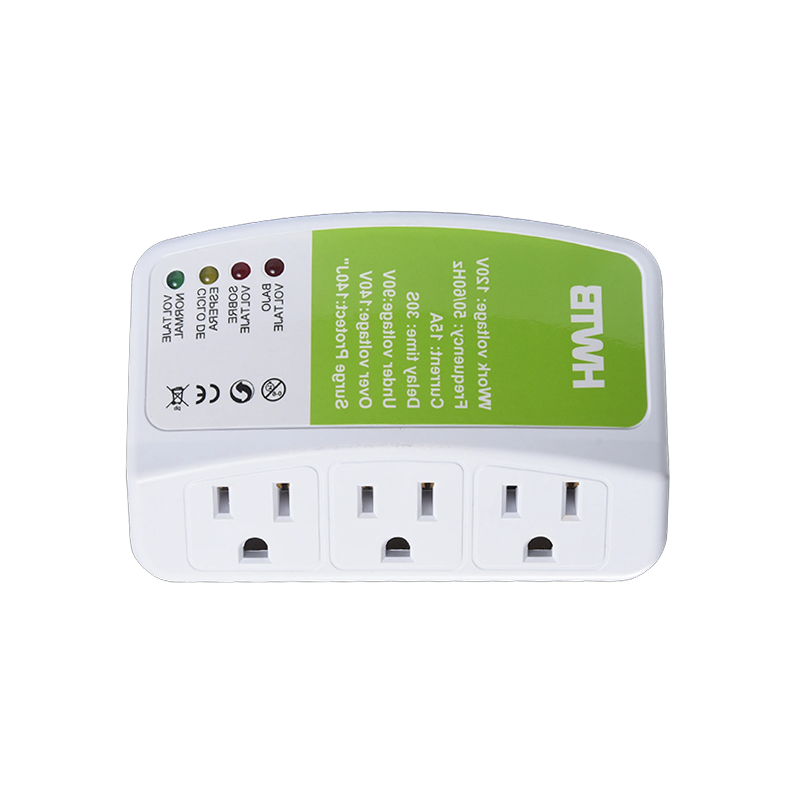 HWTB-V005 120V 15A Multi-Outlet Automatic Voltage Surge ProtectorA multi-outlet 120V/60Hz protector rated 15A/1800W, cutting off below 90V and suppressing surges from 140V. It suits the home media cluster described above, shielding a TV, soundbar and console from one protected point.View Product →
For a lone television with nothing else attached, a single-outlet 15-amp unit does the same work in a smaller shell. Whichever shape you choose, glance at the status light now and then; when the protection indicator goes dark, the sacrificial components inside have spent themselves and the unit should be replaced.
Success. One protected point, indicator lit, delay set, console and soundbar behind the same circuit as the screen — that arrangement covers every realistic risk short of a direct lightning strike.
One Living Room, Two Grid Standards
The same television sells into two electrical worlds. North America runs 120 volts at 60 Hz through flat-blade plugs; Europe, most of Asia and much of Africa run 230 volts at 50 Hz through round-pin standards. A protector built for one grid cannot simply be re-labelled for the other, because plug geometry, certification and voltage thresholds all change together.
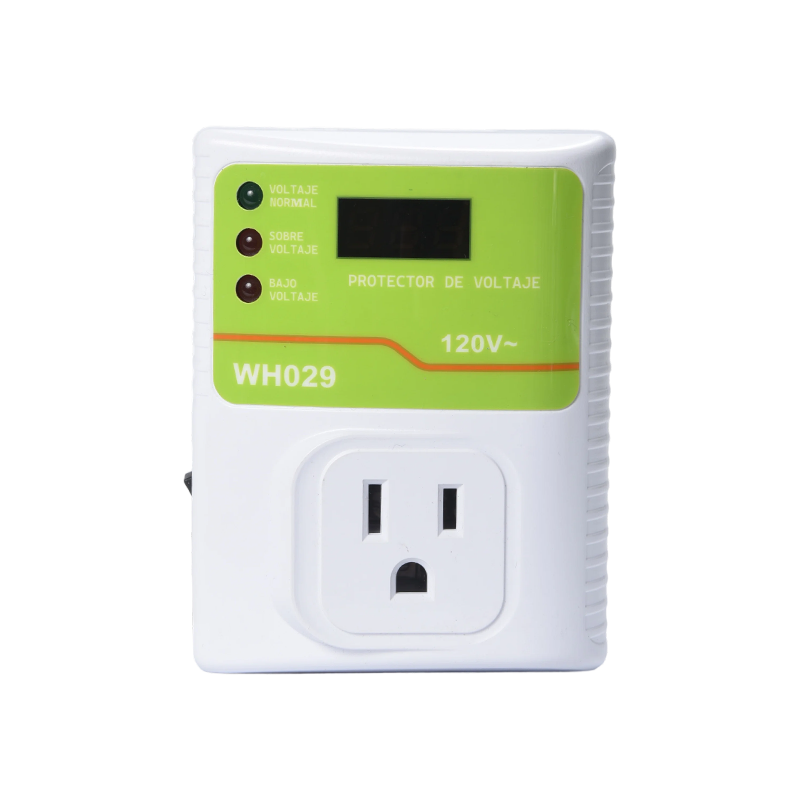
 HWTB-V006-US 110V 15A Automatic Voltage Surge ProtectorThis US-standard unit handles 120V/60Hz power with automatic over- and under-voltage cutoff, surge suppression and 3-minute delayed start. It is the workhorse North American shelf item the surrounding discussion identifies for 120-volt markets.View Product →
In the 120-volt market, a listed 120 V, 15 A automatic unit is the workhorse of the shelf: correct blade configuration, headroom for a shared media point. In the 230-volt market, CE-marked 15 A protectors play the same role, and adjustable models let one hardware platform serve several regions — set the cutoff window per market, at the factory or in the field. It is the split we manufacture into our own catalogue, with EU-standard and US-standard lines side by side and 30-amp air-conditioner variants for the heavier loads next door.
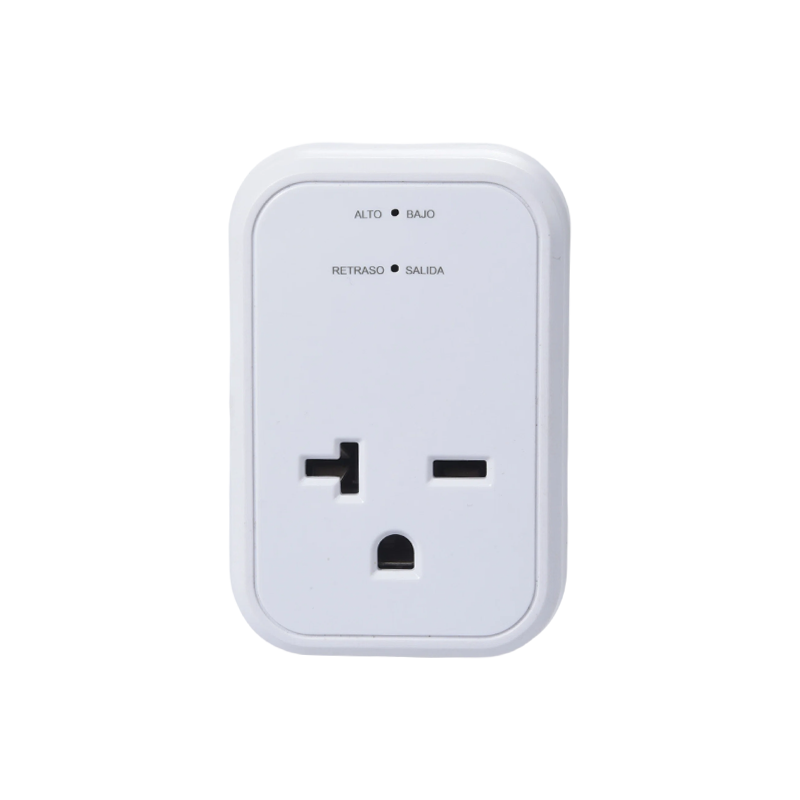
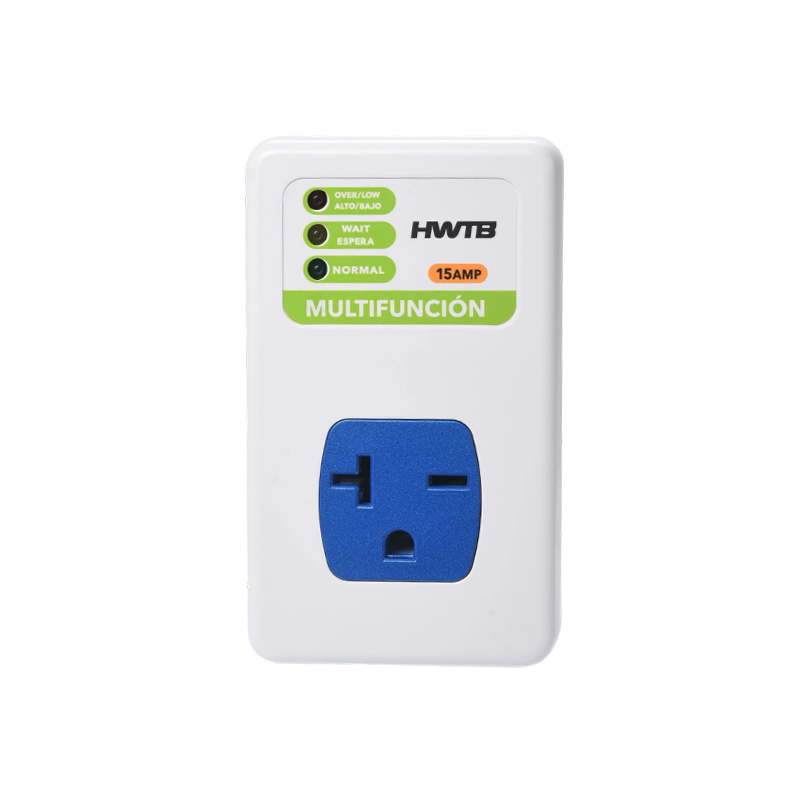 HWTB-V016-CE 230V 15A Automatic Voltage Surge ProtectorBuilt for 230V/50Hz grids, this CE protector interrupts between 90V and 140V with copper conductors, microprocessor control and an optional 125J surge module, serving the round-pin markets discussed in the preceding paragraphs.View Product →
Buyers assembling either assortment can prevent most after-sales complaints with three checks:
- Confirm the plug standard and certification for the destination market, not merely the voltage printed on the housing.
- Read the reconnect delay specification; an instant-return unit quietly undermines the protection story you are selling.
- Prefer adjustable cutoffs where one product must cover regions whose grids behave differently.
For the fuller picture, our comprehensive guide to voltage protector working principles and types covers the design landscape from cutoff logic to surge handling.
The Bottom Line
Decide from the grid inward. Stable supply with the occasional storm: a surge protector with a real joule rating, replaced when its indicator dies. Sags at compressor start and creep at night: an automatic voltage protector with a tuned window and a patient reconnect delay. Generator or weak-feeder supply: a regulator, with a surge stage behind it. Lightning country: both, layered.
The television is probably the most expensive appliance in the room, and the device guarding it costs a fraction of one percent of its price. Matching the two to each other, rather than to the loudest packaging claim, is the whole exercise.
Recommended Products
News
-
-
Appliance Protection The Quiet Threat to Your Microwave: Why Voltage Protection Deserves a Second Look A practical guide to overvoltage and undervolt...
READ MORE -
The low and high voltage protector has one primary job: it monitors the incoming supply and disconnects the load whenever the voltage stays above or ...
READ MORE -
After a grid fault pushes the voltage in your home above 280 V or below 165 V for even a few seconds, the compressor in your refrigerator or air cond...
READ MORE -
With the improvement of residents' awareness of electrical safety and the rapid development of the smart home market, over/under voltage protector sm...
READ MORE -
With the continuous increase of electrical safety supervision, the certification system of the over/under voltage protector smart socket industry is ...
READ MORE

Ningbo Haowei Electric Technology Co., Ltd.
-
Address
No. 261 Lvyuan 2nd Road, Chongshou Town, Qianwan New Area, Ningbo City, Zhejiang Province, China
-
Mobile
+86-13566611998
-
Email
Copyright © Ningbo Haowei Electric Technology Co., Ltd. Rights Reserved.
 Custom Smart Timer Plug Manufacturers