
 English
 中文简体
 Español
 Português

Appliance Protection The Quiet Threat to Your Microwave: Why Voltage Protection Deserves a Second Look A practical guide to overvoltage and undervolt...
READ MORE
Industry News
Home / News / Industry News / Do You Need a Voltage Protector for an Inverter? A Practical Buyer's Guide
Do You Need a Voltage Protector for an Inverter? A Practical Buyer's Guide
Update:08-10-2026
Power Protection Guide
Do We Need a Voltage Protector for an Inverter?
Most inverters defend themselves better than their owners expect. The equipment that fails first usually sits downstream, and that changes both the answer and the wiring.
The short answer: protect the load, not the inverter
If your inverter is a modern grid-tied, hybrid or off-grid unit with a configurable AC voltage window and a restart delay, a separate protector upstream of it changes very little. The inverter already samples grid voltage, disconnects when the supply leaves its window and waits before reconnecting. A second device in series adds a second trip point, not a second layer of intelligence.
The case for a protector appears when the asset you are afraid of losing is not the inverter. Air conditioners, freezers and borehole pumps lose torque with the square of the applied voltage: at 190 V on a 230 V motor, starting torque falls to roughly 68% of nominal while running current climbs. The compressor starts harder, runs hotter and eventually fails.
The useful question, then, is not whether an inverter needs protection, but which of two very different events you are guarding against.
| Event | Time scale | First line of defence | Covered by the inverter |
|---|---|---|---|
| Lightning or switching transient | Microseconds to milliseconds | Surge protective device at the panel | No |
| Sustained overvoltage, 250-270 V on 230 V nominal | Minutes to hours | Voltage protector with an upper limit | Partly |
| Undervoltage with a motor load, 170-200 V | Minutes to hours | Voltage protector with a lower limit and delay | Partly |
| Frequency drift | Seconds | Inverter itself | Yes |
| DC string overvoltage or reverse current | Milliseconds | String fusing, DC isolator, MPPT limits | Yes |
Read the table as a division of labour: the inverter handles frequency, DC limits and its own hardware, while the protector handles slow voltage drift on the load side.
What your inverter already handles by itself
A modern inverter is a voltage monitor with a power stage attached. On 230 V nominal systems, common AC windows sit around 184 V to 253 V; on 120 V nominal units using North American grid codes, closer to 88 V to 132 V, with frequency limits near 47-52 Hz and 59.3-60.5 Hz. Hybrid units add an MPPT range and a DC low-voltage disconnect.
The boundary worth understanding is that the inverter measures at its own terminals, not at the appliance. A long, undersized feeder can drop twenty volts between the inverter and a compressor while the inverter still reads an entirely acceptable figure.
It also helps to separate two jobs. Fast, high-energy events belong to a surge protective device; slow deviations belong to a voltage protection device, whose measuring and switching behaviour is explained in this note on what a voltage protector actually does. Expecting a plug-in protector to absorb a lightning strike is one of the more expensive misunderstandings in this category.
Info: two devices, two jobs. A Type 2 or Type 3 surge protective device clamps spikes in microseconds; a voltage protector measures true RMS voltage over a short window and disconnects the load for seconds or minutes. Buying one does not remove the need for the other.
Five situations where the extra device earns its place
A voltage protector is a sensible addition in these conditions, and rarely anywhere else.
- Weak rural feeders, where the supply sags below 200 V under load and climbs above 250 V overnight.
- Dense rooftop solar areas, where aggregated export pushes local voltage toward the upper trip limit at midday.
- Motor loads such as air conditioners, chillers, freezers and pumps, where undervoltage converts directly into heat.
- Generator or small-hydro supply, where voltage recovers slowly after a load step.
- A single distribution point feeding several appliances, where one device can look after a whole branch.
In each case the value comes from adjustable thresholds and a matching reconnect delay, not from the word "protection" printed on the housing. A fixed-window device trips on supplies that a properly tuned one would ride through.
Voltage protection is rarely about the inverter. It is about the compressor that cannot start at 180 volts and the control board that will not tolerate 260.
Consider a shared 120 V supply point feeding an air conditioner, a refrigerator and a router from one outlet. A 15 A multi-outlet unit with an adjustable lower limit holds the branch offline during a brownout and restores it only once the voltage is genuinely stable, instead of letting the compressor attempt a start on 95 V.
When a protector is unnecessary, or actively unhelpful
Four situations are worth recognising before you add a device.
- The inverter is the only asset at risk and already has an adjustable grid window with a restart delay.
- Two devices disagree: countdown timers with different settings produce connect-disconnect cycles that stress contactors and compressors more than the original fault would.
- The supply dips twenty times a day, and a protector cuts power on every dip.
- The protector is papering over a wiring fault such as an undersized feeder, a loose neutral or a badly sized generator.
Warning: nuisance tripping is the most common complaint about misapplied voltage protection. Where the load is a refrigerator or freezer, a device that trips on every shallow dip costs more in spoiled stock than it saves in hardware.
Danger: a plug-in voltage protector is an AC device, so never treat it as DC-side protection, and never wire one so that it bypasses residual-current devices, grounding or the inverter's anti-islanding function. String circuits need DC-rated fusing and a proper DC isolator, because interrupting a live string under load creates an arc no plug-in product is designed to handle.
Sizing: eight checks before you place an order
- Nominal voltage and plug standard, 230 V for EU and UK or 120 V for US, verified against the site rather than the catalogue.
- Current rating matched to the upstream breaker rather than the appliance label; a 15 A device on a 30 A circuit protects nothing.
- Power capability at your actual voltage, since 3300 W at 230 V is about 14.3 A.
- Adjustable upper and lower thresholds, so a marginal supply can be tuned rather than tripped all day.
- Reconnect delay of one to five minutes; three minutes lets a compressor equalise pressure before restart.
- Housing and outlet count, single or multiple outlets, plug-in or wall-mounted, matched to the wiring.
- Import documentation: CE marking, ISO 9001 quality records and test evidence a reviewer will accept.
- Thermal behaviour, because contacts rated for 16 A on a bench are not contacts rated for 16 A in an enclosure at 45 °C.
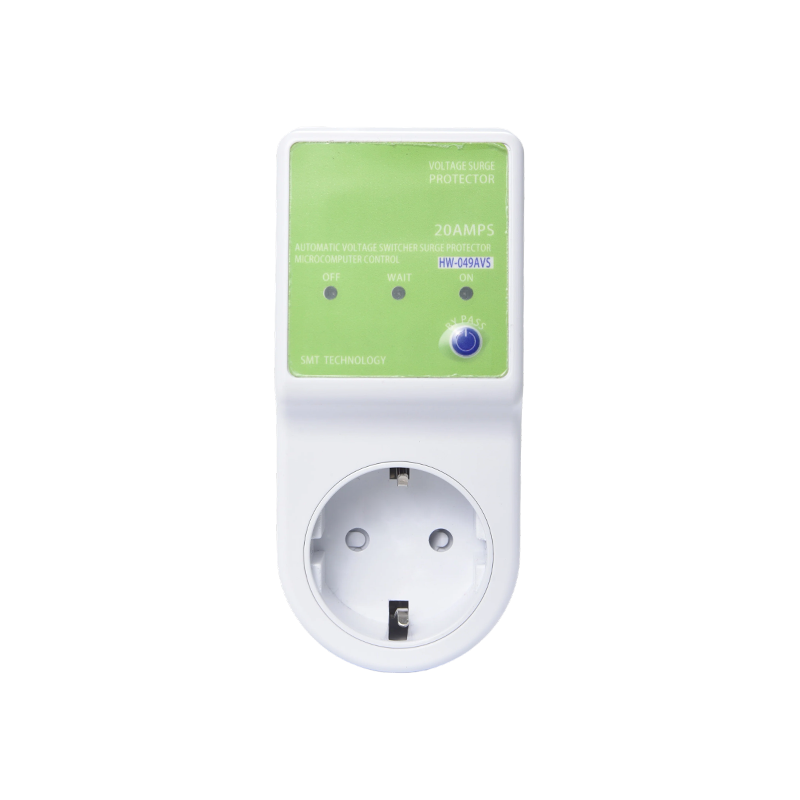
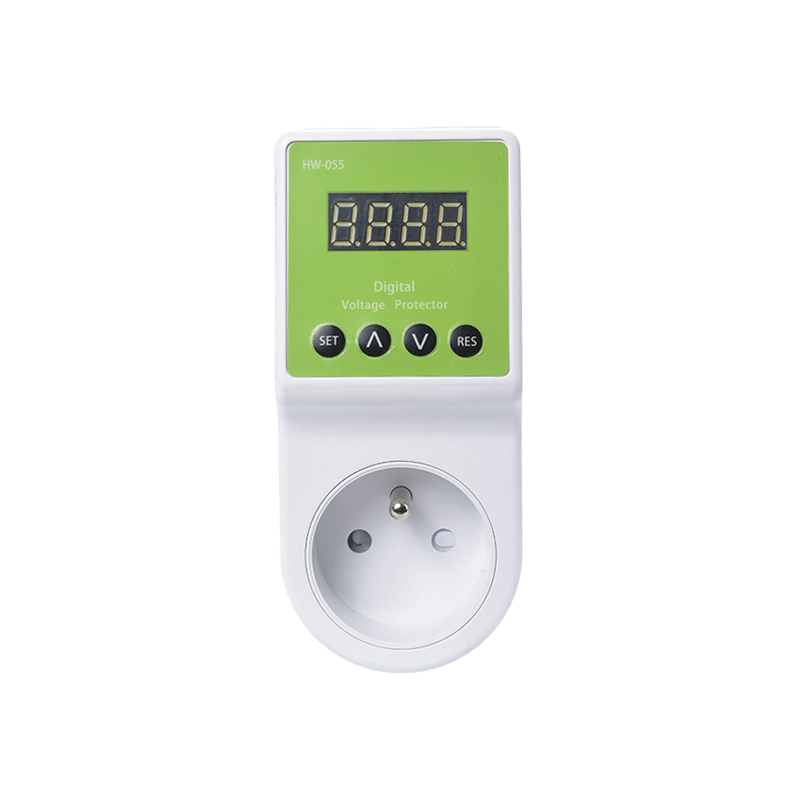
Buyers who need both standards usually consolidate with one over- and under-voltage protection device manufacturer instead of qualifying two supply chains, since the adjustable-threshold logic and much of the housing tooling carry across both ranges.
Where the protector goes in the circuit
Working outward from the utility connection, a rational order runs: main breaker, a Type 2 surge protective device at the panel, any voltage protection your local code requires, the inverter's AC input or backup port, and finally the protected branch.
- On the inverter output, between the backup supply and the loads you cannot afford to lose. This is where motors live, and it is the placement that repays its cost.
- At the incoming supply, where local wiring rules require a voltage protection device regardless of the inverter. It protects the inverter as a side effect, but it is not a substitute for anything downstream.
Protecting the inverter's own AC input has the least return, because on a grid-tied system it duplicates work the inverter already performs. For a dedicated circuit, match the device to the branch: a 120 V 30 A unit suits a large single air conditioner on its own breaker, where a 15 A model would sit permanently at its limit.
Success: one device, one job, one delay. Protection works best when it is the only thing deciding when a load comes back, with thresholds set slightly inside the limits the equipment is rated for.
The bottom line
Most inverters do not need an external voltage protector, because they already measure the grid and disconnect from it. Loads often do, particularly motors on weak networks or on feeders carrying a lot of rooftop solar.
If the risk you are worried about is a lightning strike, buy a surge protective device. If it is a compressor on a supply that wanders between 180 V and 260 V, buy an adjustable protector with a delay, size it to the breaker and install it in front of the motor. If it is the inverter itself on a reasonably stable grid, spend the money on correct cable sizing and a panel-mounted surge device instead.
One last practical point: protection you cannot tune is protection you will eventually unplug. Adjustability and a matched reconnect delay matter more than an extra amp of headline rating.
Recommended Products
News
-
-
Power protection, explained Voltage Regulator or Surge Protector for TV: Which One Does Your Screen Need? Spikes, sags and slow brownouts damage a te...
READ MORE -
What Is a Voltage Protector? A voltage protector is an electrical device that monitors incoming line voltage and automatically disconnects power to c...
READ MORE -
After a grid fault pushes the voltage in your home above 280 V or below 165 V for even a few seconds, the compressor in your refrigerator or air cond...
READ MORE -
With the improvement of residents' awareness of electrical safety and the rapid development of the smart home market, over/under voltage protector sm...
READ MORE -
Voltage Protection Field Notes Dual Voltage Surge Protectors: What Actually Protects 110V and 230V Equipment Two numbers on one housing, two very dif...
READ MORE

Ningbo Haowei Electric Technology Co., Ltd.
-
Address
No. 261 Lvyuan 2nd Road, Chongshou Town, Qianwan New Area, Ningbo City, Zhejiang Province, China
-
Mobile
+86-13566611998
-
Email
Copyright © Ningbo Haowei Electric Technology Co., Ltd. Rights Reserved.
 Custom Smart Timer Plug Manufacturers