
 English
 中文简体
 Español
 Português

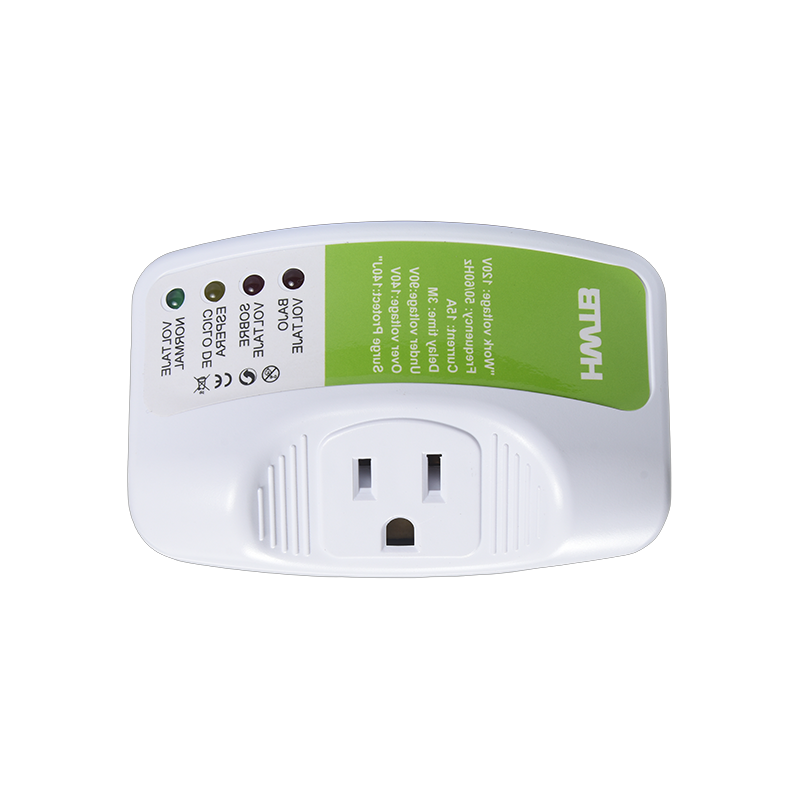
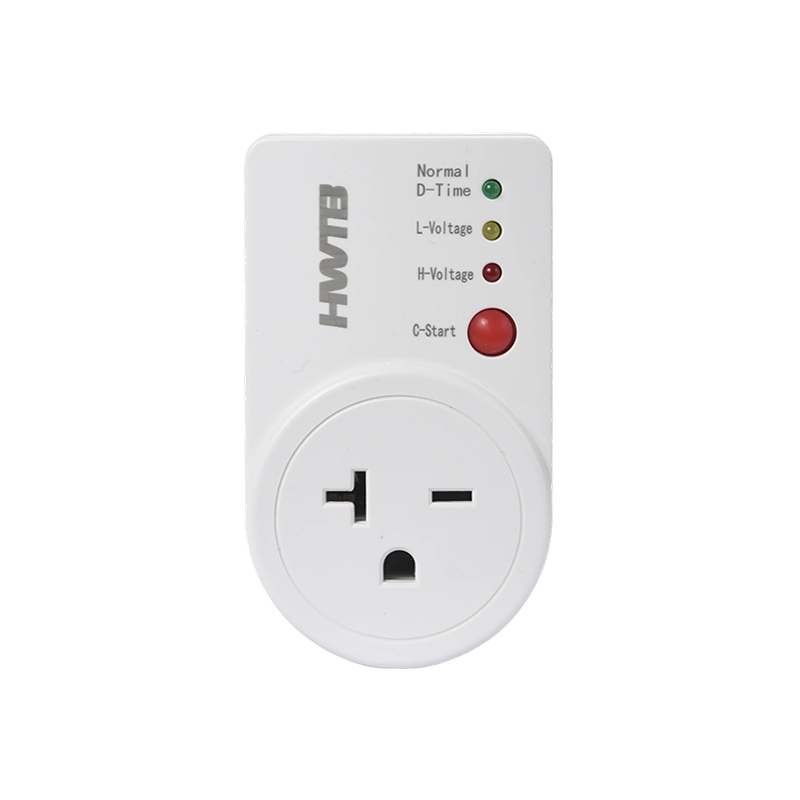
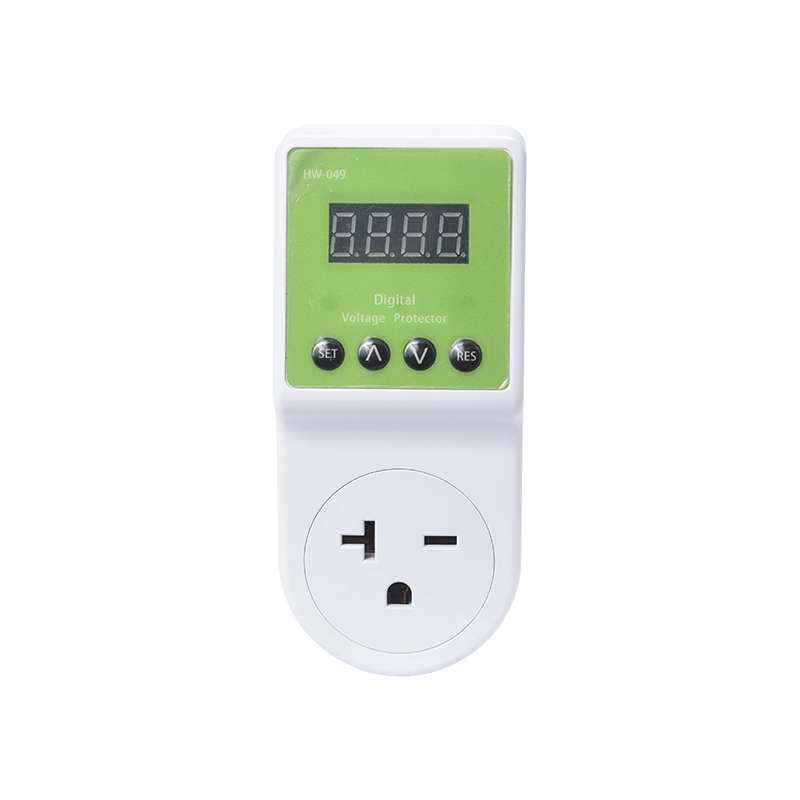
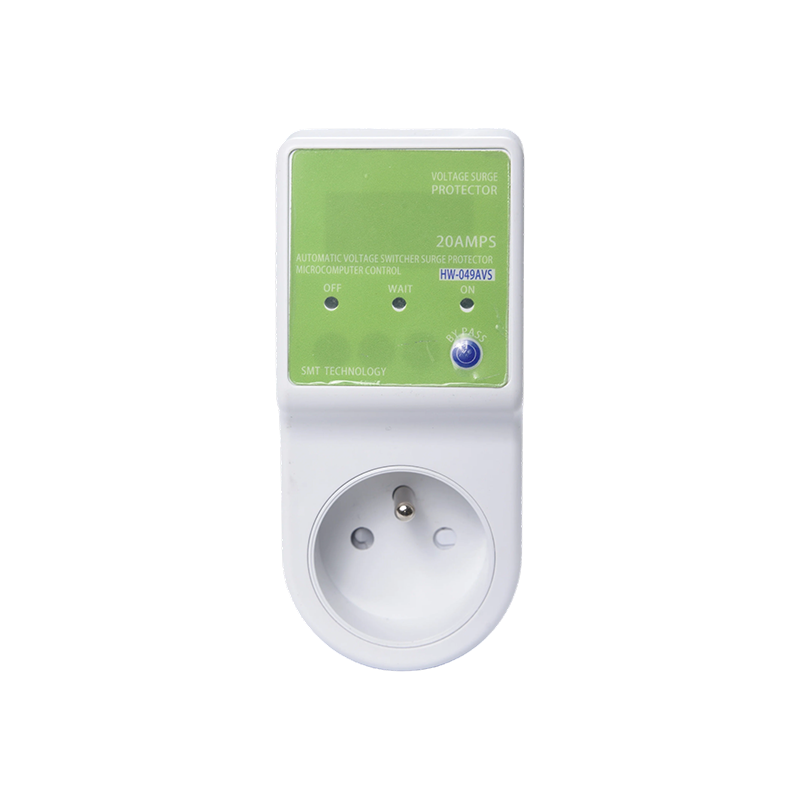
Voltage Spike Protector Outlet: What It Is, Key Specs, and How to Choose Behind many appliance failures is not a dramatic lightning strike but a bri...
READ MORE
Industry News
Home / News / Industry News / TV Voltage Protector: How It Saves Your Television from Grid Instability
TV Voltage Protector: How It Saves Your Television from Grid Instability
Update:26-10-2026
Power Protection · Television & A/V Systems
TV Voltage Protector: The Last Device Between the Grid and Your Screen
You chose the panel, the stand, and the soundbar with care. The one thing standing between all of it and a brownout is a small protector that costs a fraction of the screen’s price. Here is how it works, what it actually saves, and the specifications that separate a real voltage protector from a power strip.
A 65-inch television rarely dies from a defect in the panel. It dies from the grid. Repeated over-voltage events age the power supply, deep brownouts force it to overwork, and short transients can take out the driver circuit in a microsecond. A TV voltage protector is the device that makes sure none of that reaches your screen. It sits between the wall outlet and the television, watches the incoming voltage continuously, and disconnects the load the moment the line leaves the safe window. When the grid recovers, it reconnects. That is the entire job — and it is the cheapest insurance a television setup can have.
What a TV Voltage Protector Actually Does
It does not filter electricity in the way a line conditioner does, and it does not smooth noise. It monitors. Under normal conditions it remains invisible, passing power through a relay without interfering with picture or sound. When the voltage rises above or falls below the trip thresholds, the relay opens and the television loses power safely. After the preset restart delay, the relay closes again and the TV boots back up.
This is the difference most people overlook.
A surge protector clamps the blast. A voltage protector cuts the connection. The television on your wall needs the second at least as much as the first.
A power strip with a surge-clamping element limits short, violent spikes, but it stays connected during a brownout or a sustained over-voltage — precisely the events that stress a switching power supply the most. A protector with under- and over-voltage cutoff handles both directions, which is why the engineering world calls it an automatic voltage protector rather than a surge protector. For a deeper look at the internal mechanisms, our guide to voltage protector working principles and types walks through the difference between cutoff and clamping in detail.
Many modern protectors combine surge clamping and over/under-voltage disconnect in one housing. If the label says “automatic voltage protector” or “auto voltage surge protector,” it does both. If it only says “surge protector,” it does not cut power when the line voltage drops.
Why Modern Televisions Are More Vulnerable Than the Screens You Grew Up With
A contemporary TV is never truly off. In standby mode the switching power supply stays active, the main capacitor holds charge, and the control board watches for a wake signal around the clock. That means the television is connected to the grid — and exposed to its mood swings — twenty-four hours a day, even while you are on a business trip.
The components inside are smaller than their 1980s ancestors and run closer to their thermal limits. Electrolytic capacitors in the primary circuit of a switch-mode supply are rated for a certain amount of ripple and heat; over-voltage pushes them past both. A brownout makes them compensate by drawing more current, which raises operating temperature and accelerates aging. Neither event needs to be dramatic. A grid that drifts for months will degrade a TV supply long before any single storm event destroys it.
| Grid event | Typical trigger | Effect on the TV |
|---|---|---|
| Over-voltage | Line rises above 253 V (EU) or 127 V (US) | Power supply runs hot; capacitor electrolyte ages faster |
| Under-voltage / brownout | Line drops below 207 V (EU) or 104 V (US) | Power supply draws more current to hold output; temperature rises |
| Transient surge | Lightning nearby or inductive loads switching off | Can puncture rectifier diodes or panel driver ICs; often fatal |
| Rapid power cycling | Grid instability or breaker reclosing | Repeated inrush current degrades input capacitors and resets protection logic |
The table shows why a voltage protector is the right broad-spectrum answer: it covers over-voltage, under-voltage, and rapid cycling, while the surge-clamping element inside the same housing covers transients.
The Numbers That Matter When Buying a TV Voltage Protector
Four specifications decide whether a protector fits your television: voltage range, current rating, response time, and restart delay. Certification marks matter more than brand names, and the model must match the grid standard of the country where the TV is installed.
| Specification | What to look for | Why it matters |
|---|---|---|
| Voltage range | 230 V models for EU; 110–120 V models for US | Mismatching the standard trips the unit at the wrong threshold |
| Current rating | 10 A, 13 A, 15 A, or 30 A | A large TV draws 1.5–3 A; adding peripherals brings a 10 A unit to its limit |
| Adjustable trip points | Screwdriver-adjustable thresholds | Lets you tune cutoff values for a chronically unstable grid |
| Response time | Tens to hundreds of milliseconds | Must react faster than the TV’s own power supply |
| Restart delay | 30 seconds to 5 minutes | Prevents reconnection while the grid is still settling |
For a typical living room, a 15 A unit is the sensible middle ground. It comfortably covers a television, a soundbar, a streaming box, and a console at the same time. If the entertainment center also includes a power-hungry amplifier or subwoofer, stepping up to a 30 A model gives headroom without changing the protection concept.
Match the Protector to Your Grid, Not to a Brand
Voltage protectors are built around a specific grid standard, and that is the one decision a plug adapter cannot fix. A 230 V European protector connected to a 120 V American circuit will interpret the normal line voltage as a deep undervoltage and disconnect permanently. A 120 V unit on a 230 V EU grid will likely damage itself on the first over-voltage event.
For European households, the reference is a 230 V, CE-marked protector with a Schuko or CEE 7/7 plug and a frequency rating that matches the 50 Hz supply. The HWTBV002, rated at 220 V and 15 A with adjustable trip points, sits squarely in that category, and gives the television a cutoff window that can be tuned to local conditions.
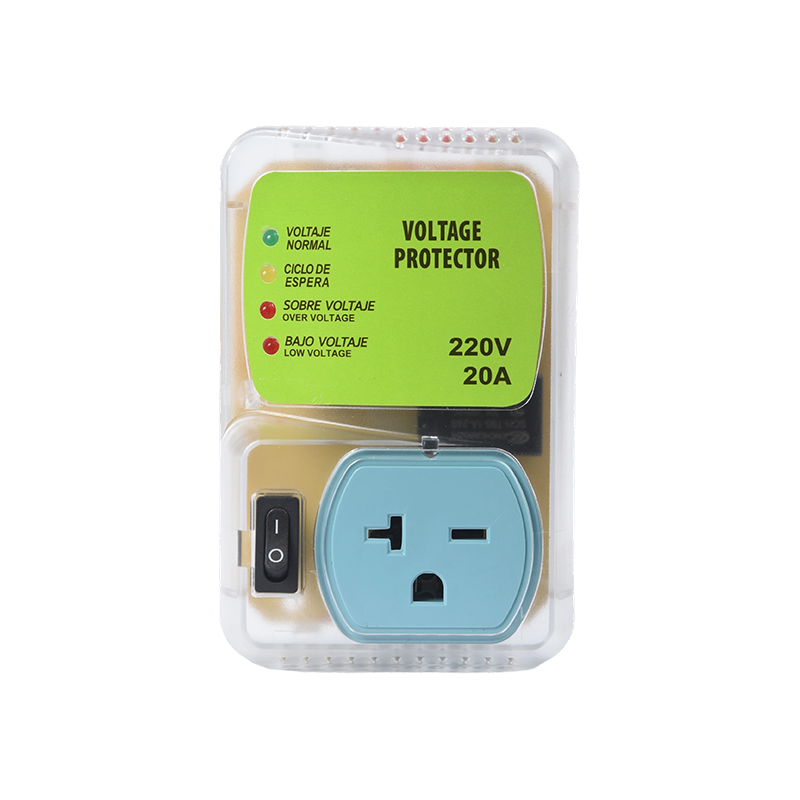 HWTBV002 Adjustable Voltage Protector for European GridsThis 230V, 15A CE-marked protector suits EU households, offering adjustable trip points for 50Hz supplies and protecting A/V equipment from voltage fluctuations.View Product →
For North American households, the protector must use the NEMA 5-15 form factor, suit a 110–120 V circuit, and carry the appropriate certification for 60 Hz distribution. The HWTBV001US, a 120 V, 15 A adjustable model, is the equivalent entry point. The word “air conditioner” in the product name is a load rating, not a restriction — the same protector runs a television perfectly well, and the 15 A current rating is exactly the headroom an A/V stack needs.
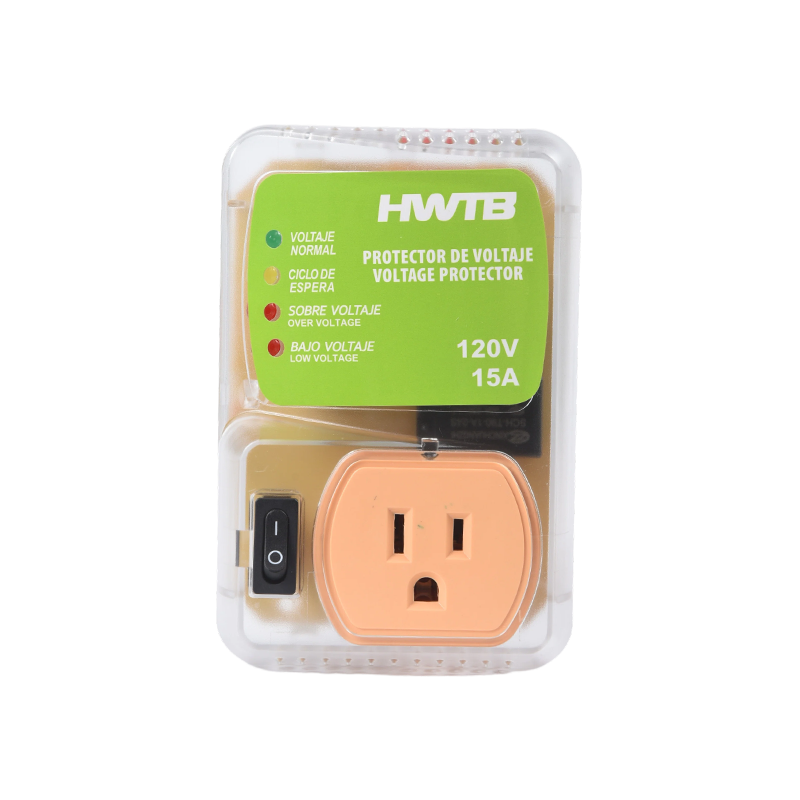 HWTBV001US Adjustable Voltage Protector for North AmericaA 120V, 15A adjustable protector with NEMA 5-15 plug, ideal for US homes, providing voltage headroom and surge protection for televisions and other devices.View Product →
If the region has chronic instability — rural feeders, frequent storm cutovers, or old building wiring — choose a model with adjustable thresholds. Fixed-threshold units allow normal drift, but adjustable models let a technician set the cutoff closer to actual grid conditions. Every entry in our voltage protector product range is organized around this EU/US split, so the search narrows quickly once the grid standard is confirmed.
Where and How to Install It
Install the protector between the wall outlet and the television, never after an extension cord. The shorter the copper path from the breaker panel to the relay, the less opportunity a transient has to couple into household wiring before protection is applied.
For a wall-mounted TV, place the protector near the outlet so the relays can click freely and any indicator is visible. Leave slack in the cord, and do not force the protector into a compact cavity where heat from the television or the protector itself gets trapped.
Do not connect the TV through both a UPS and a voltage protector in series. The protector’s relay may react to the UPS switching to battery and cut power even though the UPS is delivering clean voltage. One protection path is enough; two in series create conflicting trip decisions.
If the TV shares a wall with a game console, a streaming box, and a soundbar, a single multi-outlet unit simplifies the whole arrangement. The HWTBV005 groups several sockets behind one relay and one surge-clamping stage, so the TV and its peripherals cut and reconnect together instead of acting on different timings.
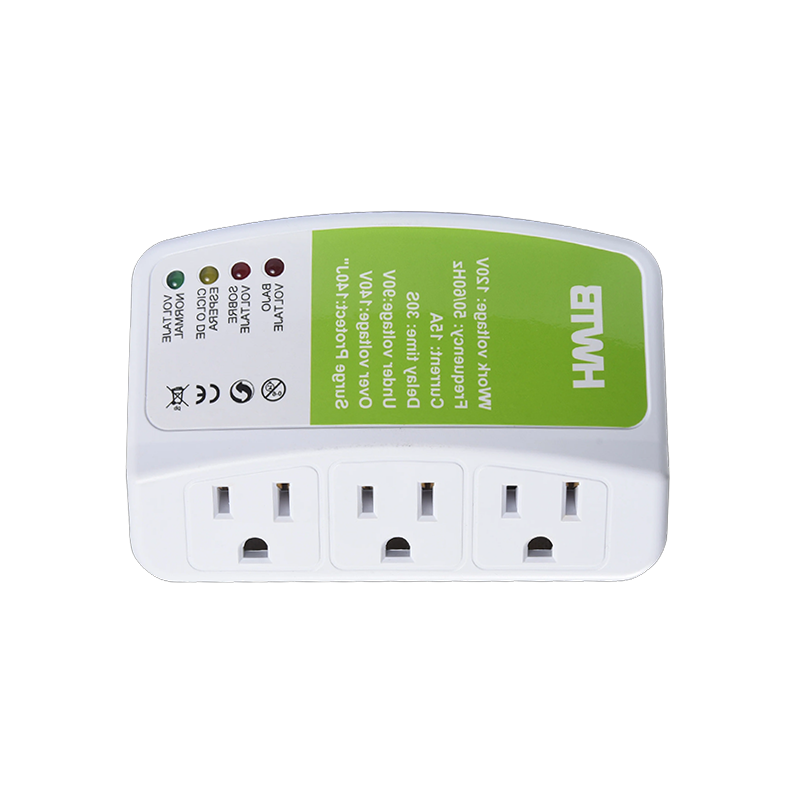 HWTBV005 Multi-Outlet Voltage and Surge ProtectorThis multi-socket unit guards a TV and peripherals together with one relay and surge stage, simplifying coordination and protecting against voltage anomalies at 120V.View Product →
The Buying Route That Covers the Real Risks
Work through these checks in order, and the field of options becomes manageable.
- Confirm the grid standard first: 230 V / 50 Hz in Europe and most of Asia; 110–120 V / 60 Hz in North America. This decision determines the entire product family.
- Add up the A/V load. A 65-inch TV, soundbar, and console rarely exceed 5 A; a 15 A unit leaves generous headroom for future devices.
- Decide between fixed and adjustable thresholds. Fixed is fine for stable urban grids; adjustable suits rural or frequently disturbed supplies.
- Check the label for both over-voltage and under-voltage cutoff, not surge protection alone.
- Confirm the certification mark for your market — CE for EU grids, UL-style marks for the US.
The right protector is the one that never visibly does anything. It clicks once a year — twice, if you are unlucky — and every click means something expensive just did not break.
A television is one of the most expensive single appliances in a home, and the grid feeding it is rarely as stable as the outlet suggests. A TV voltage protector does not change the picture quality, does not add a single feature, and does not ask for attention during its working life. It simply refuses to let the grid kill the panel.
The grid will not become more predictable. The protector’s job is to make sure that unpredictability never reaches the panel.
Recommended Products
News
-
-
After a grid fault pushes the voltage in your home above 280 V or below 165 V for even a few seconds, the compressor in your refrigerator or air cond...
READ MORE -
Power protection, explained Voltage Regulator or Surge Protector for TV: Which One Does Your Screen Need? Spikes, sags and slow brownouts damage a te...
READ MORE -
The low and high voltage protector has one primary job: it monitors the incoming supply and disconnects the load whenever the voltage stays above or ...
READ MORE -
With the improvement of residents' awareness of electrical safety and the rapid development of the smart home market, over/under voltage protector sm...
READ MORE -
Appliance Protection The Quiet Threat to Your Microwave: Why Voltage Protection Deserves a Second Look A practical guide to overvoltage and undervolt...
READ MORE

Ningbo Haowei Electric Technology Co., Ltd.
-
Address
No. 261 Lvyuan 2nd Road, Chongshou Town, Qianwan New Area, Ningbo City, Zhejiang Province, China
-
Mobile
+86-13566611998
-
Email
Copyright © Ningbo Haowei Electric Technology Co., Ltd. Rights Reserved.
 Custom Smart Timer Plug Manufacturers